How does ink drying work?
Back to Knowledge BaseThe explanations regarding ink drying relate to absorbent cardboards and papers with a coated surface. The physical and chemical properties of the printing ink are key determinants of ink drying. Printing inks are formulated from colourants, binders, solvents and additives (to achieve specific properties).
Ink drying takes place in two phases.
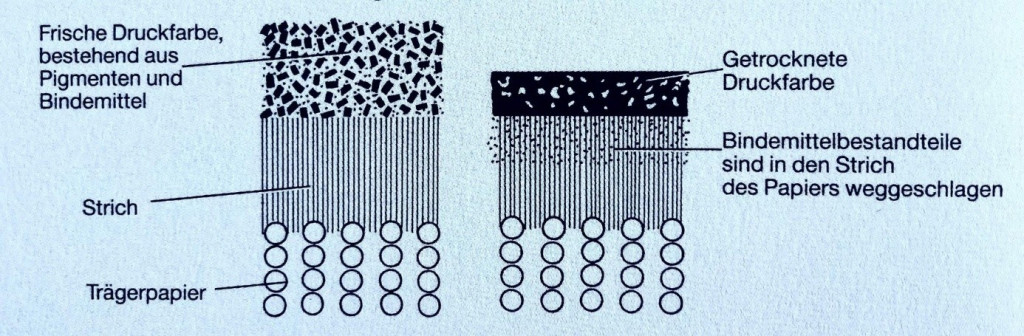
Ink removal
Ink removal refers to the very rapid process by which the oily components of the printing ink penetrate the microporous surface of the substrate. Through the capillary action of the minute pores in the coating, the oily substances in the printing ink penetrate the surface and thus separate from the binders.
Oxidation
Once the oily substances have penetrated the microporous surface, chemical oxidation takes place immediately, resulting in the transition from a liquid to a solid state. During this process, the binders encapsulate the colour pigments in the printing ink, which must be permanently and mechanically securely fixed to the surface of the substrate. The binders also serve to ensure the ink’s flow properties for transport during the printing process. Typical binders are natural or synthetic resins. The oxidation of the binders is a chemical process in which oxygen is absorbed from the ambient air and, through a chain reaction within the binder, a stable and solid ink layer is formed. Oxidative drying takes place over several hours before the ink coating is completely set and dry.
To avoid the waiting time required for the ink coating to dry through completely, a dispersion varnish is very often applied; this protects the still-wet ink coating, acts as a print finish and enables faster further processing.